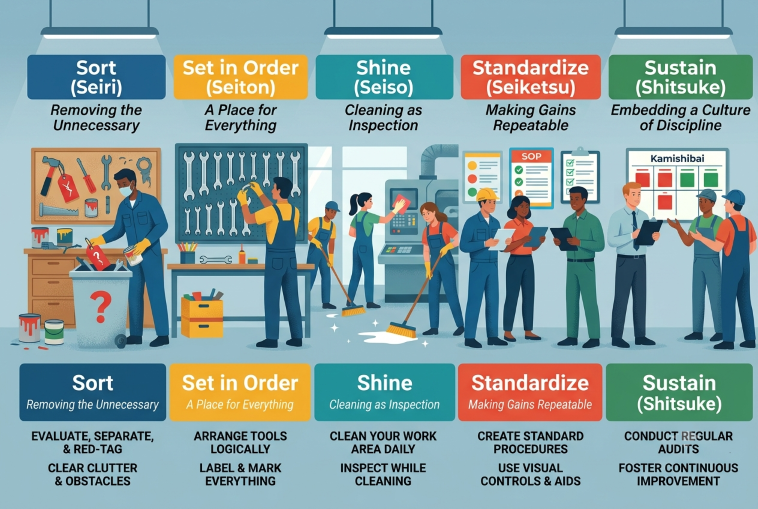
5S Visual Management: Framework & Workplace Examples
Introduction
Originating from the Toyota Production System, 5S Visual Management is not just a cleaning program but an organizational discipline that establishes a physical and visual baseline for efficiency.
Here is how each of the five pillars systematically eliminates chaos and improves workplace productivity:
1. Sort (Seiri):
Removing the UnnecessaryThe first step is to distinguish between what is needed for immediate operations and what is obsolete or redundant.Action: Items are evaluated based on frequency of use; if an item is not used regularly, it is removed.Red-Tagging: Questionable items are marked with a red tag and moved to a designated holding area (quarantine zone). If they remain unallocated after a set period (typically 30 days), they are discarded or sold.Impact: This dramatically frees up floor space, reduces search time, and eliminates the physical and cognitive distractions caused by clutter.
2. Set in Order (Seiton):
A Place for EverythingOnce the workspace is decluttered, the remaining essential items are arranged in a logical, ergonomic manner.Action: Tools and materials are positioned based on their frequency of use—daily tools stay within arm’s reach (the “primary strike zone”) to minimize wasted movement.Visual Controls: This phase uses shadow boards (outlines showing where tools go), floor markings, and clear labels.Impact: This ensures that “everything is in its place,” slashing the time spent searching for tools and making missing items instantly noticeable.
3. Shine (Seiso):
Cleaning as Inspection”Shine” moves beyond simple tidying to integrate cleaning with regular inspection and proactive maintenance.Action: Every employee is responsible for cleaning their specific area and equipment.Principle: “Cleaning is inspection.” As workers scrub machinery, they are trained to look for “micro-abnormalities” like oil leaks, hairline cracks, or loose bolts.Impact: This detects early signs of wear before they escalate into catastrophic, unplanned equipment failures, thereby maximizing uptime.
4. Standardize (Seiketsu):
Making Gains RepeatableStandardization is the mechanism that prevents a workplace from regressing into chaos after an initial cleanup event.Action: Organizations document Standard Operating Procedures (SOPs) and post visual work instructions at each station. Visual aids, such as photos of the “ideal state,” provide an instant point of comparison.Impact: It ensures that Sort, Set in Order, and Shine become part of the daily routine rather than a one-time project, maintaining consistent conditions across all shifts.
5. Sustain (Shitsuke):
Embedding a Culture of DisciplineThis most challenging step focuses on the self-discipline and habits required to maintain standards long-term.
Action: Success is driven by visible leadership commitment, ongoing training, and regular audits.
Auditing Tools: Many organizations use Kamishibai boards—a visual audit system using red/green cards to confirm that standards are being met.
Impact: When 5S becomes “the way we work” rather than a set of rules to follow, it fosters a culture of ownership and continuous improvement (Kaizen).
Real-World Applications:
Office vs. FactoryImplementing visual management goes beyond manufacturing shop floors; it applies equally to corporate office environments:
In the Warehouse: Floor tape designating clear walkways, designated zones for raw materials, and shadow boards for maintenance tools.
In the Office: Standardized digital folder structures, color-coded physical filing systems, and shared supply stations with clear minimum-maximum inventory markers.
Conclusion: By embedding 5S into your daily operations, organizations transition from reactive firefighting to proactive efficiency. To learn more about aligning operational frameworks, check out our guide on Bridging the Execution Gap: From Corporate Vision to Daily Operations.