





In today’s rapidly changing corporate landscape, Human Resources functions are undergoing a critical transformation. For years, many HR teams have operated primarily as data-enabled service providers—responding to ad hoc requests, maintaining historical records, and producing unidimensional reports on past performance. However, to remain competitive and impactful, these functions must evolve toward becoming true strategic business partners and, ultimately, strategic business drivers.
The Path to Strategic Impact
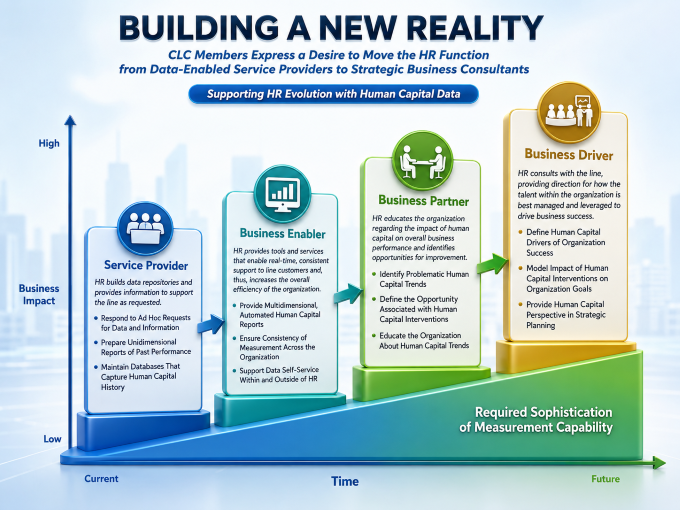
This evolution is defined by a shift in sophistication regarding how an organization utilizes human capital data. As the Corporate Leadership Council outlines in its framework, the journey toward becoming a strategic driver follows a clear trajectory:
- Service Provider: Focuses on capturing history and providing information as requested, primarily through manual, reactive reporting.
- Business Enabler: Increases organizational efficiency by providing real-time, automated, and multi-dimensional reports, while supporting data self-service to reduce the burden of ad hoc requests.
- Business Partner: Shifts the focus toward education and insight. HR begins to identify problematic human capital trends, defines the business opportunities associated with specific HR interventions, and educates the organization on how talent management influences performance.
- Business Driver: Reaches the highest level of sophistication. Here, HR actively defines the human capital drivers of organizational success, models the impact of various interventions on business goals, and provides a critical HR perspective during strategic planning.
Why This Shift Matters
The goal of this transformation is not merely to “do more with data,” but to ensure that the talent within the organization is managed and leveraged effectively to drive bottom-line business success. By moving away from reactive reporting and toward proactive modeling and forecasting, HR teams can transition from being viewed as a cost center to becoming indispensable consultants who guide leadership on how to maximize human capital.
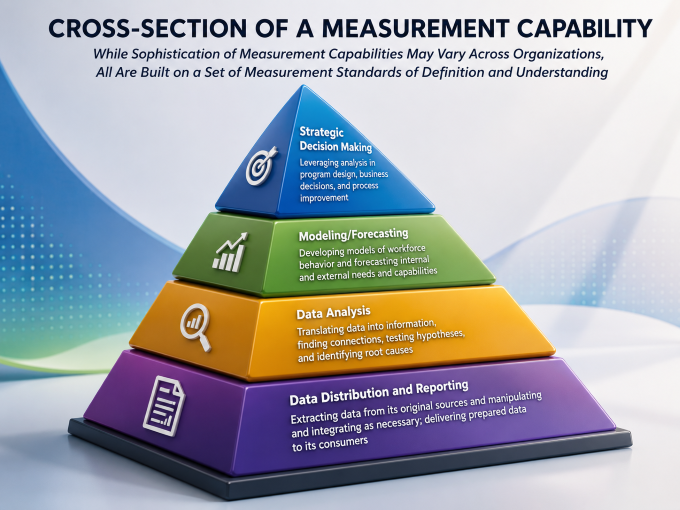
Achieving this “new reality” requires a commitment to increasing the sophistication of measurement capabilities. It demands that HR functions move beyond simple data storage to creating an environment where data informs decision-making at every level of the organization.
Reference: The Metrics Standard: Establishing Standards for 200 Core Human Capital Measures. Page:8