
Human Capital Measurement: Systematic Analysis of Workforce Metrics
Elevates People Management to A High-Level Strategic
Human Capital Management (HCM) represents a fundamental paradigm shift in how organizations treat, manage, and evaluate their workforce. Rather than viewing human resource management as merely an operational support function, HCM elevates people management to a high-level strategic issue.
The defining characteristic of HCM is “management through measurement”—the systematic collection, analysis, and reporting of workforce metrics to guide value-adding strategic investment and operational decision-making at both executive and front-line levels.
Conceptual Framework: Human Capital and HCM
To understand the role of measurement, it is necessary to examine the foundational concepts of human capital and HCM:
- Defining Human Capital Management: The Accounting for People Task Force Report (2003) defines HCM as “an approach to people management that treats it as a high level strategic issue rather than an operational matter ‘to be left to the HR people'”. As John Sunderland, Executive Chairman of Cadbury Schweppes plc, noted: “An organization’s success is the product of its people’s competence. That link between people and performance should be made visible and available to all stakeholders”.
- Human Capital Defined: Nalbantian et al. (2004) define human capital as “the stock of accumulated knowledge, skills, experience, creativity and other relevant workforce attributes”. Bontis et al. (1999) highlight that human capital represents the human factor that provides the creative thrust and learning capacity necessary for long-term organizational survival. John Kearns (2005) defines HCM as “the total development of human potential expressed as organizational value”.
- The Intellectual Capital Construct: Human capital operates within the broader construct of intellectual capital—the total stocks and flows of knowledge available to an organization. Intellectual capital comprises three interconnected elements:
- Human Capital: Individual skills, knowledge, capabilities, and discretionary behavior.
- Social Capital: The knowledge derived from internal and external networks of relationships, norms, and trust—described by the World Bank (2000) as “the glue that holds them together”.
- Organizational (Structural) Capital: The institutionalized knowledge owned by the firm and stored in databases, manuals, and systems.
- Complementing Human Resource Management (HRM): While commentators like Andrew Mayo (2001) and John Kearns (2005) argue that HCM treats workers as assets while HRM treats them as costs, Armstrong demonstrates that foundational HRM literature has always advocated viewing employees as valued assets. However, Caldwell’s (2004) survey revealed an implementation gap: while 89 per cent of respondents agreed that the top HR policy priority was “managing people as assets which are fundamental to the competitive advantage of the organization”, only 37 per cent reported making progress in implementing it. HCM strengthens HRM by providing empirical measurement frameworks to bridge this gap.
The Imperative for Human Capital Measurement
Human capital measurement is defined by IDS (2004) as “about finding links, correlations and, ideally, causation, between different sets of (HR) data, using statistical techniques”. It evaluates the actual experience and output of employees rather than stated HR policies.
Why Measure Human Capital?
Becker et al. (2001) state: “The most potent action HR managers can take to ensure their strategic contribution is to develop a measurement system that convincingly showcases HR’s impact on business performance”. Key drivers for measurement include:
- Financial Scale: Research by CFO Research Studies (2003) estimated that the value of human capital represents over 36 per cent of total revenue in a typical organization.
- Demonstrating Value Creation: Measurement proves that people add tangible value, providing a rational basis for workforce planning and evaluating HR policy impact.
- Strategic Focus: The process of collecting and analyzing data focuses corporate leadership on what must be done to attract, retain, develop, and deploy human assets effectively.
- Operational Control: Measurement reinforces the principle that “you cannot manage unless you measure”.
Cautionary Principles
Despite its importance, experts advise caution against excessive or misdirected measurement:
- Leadbeater (2000) warns that measuring can lead to cumbersome inventories that fail to explain how firms actually create value and make money.
- Hartley (2005) from the Institute of Employment Studies stresses that benchmarking numbers alone are insufficient; metrics must be explicitly linked to business performance outcomes.
- Scarborough and Elias (2002) emphasize that the specific metrics chosen are less important than the process of measuring and the strategic insights derived from the data.
Core Frameworks and Measurement Models
Armstrong highlights six major frameworks utilized by leading organizations to measure human capital:
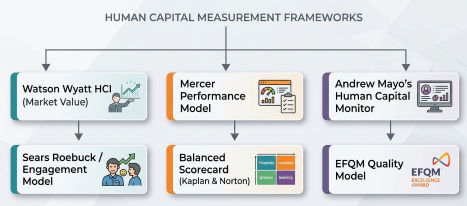
1. The Watson Wyatt Human Capital Index (2001)
Based on a study linking HR practices to market value, Watson Wyatt identified four major categories of HR practice that together account for a 30 per cent increase in shareholder value creation:
- Total rewards and accountability: Linked to a 16.5 per cent increase in market value.
- Collegial, flexible workforce: Linked to a 9.0 per cent increase in market value.
- Recruiting and retention excellence: Linked to a 7.9 per cent increase in market value.
- Communication integrity: Linked to a 7.1 per cent increase in market value.
2. Mercer HR Consulting Organizational Performance Model
Developed by Nalbantian et al. (2004), this model assesses six elements: people, work processes, management structure, information/knowledge, decision-making, and rewards. It utilizes Internal Labour Market Analysis as a statistical tool to analyze actual employee historical records, uncovering misalignment gaps between strategic requirements and actual workforce delivery.
3. Andrew Mayo’s Human Capital Monitor
Mayo (2001) calculates Human Asset Worth using the formula: Human Asset Worth = Employment Cost x Individual Asset Multiplier
The multiplier represents a weighted assessment of capability, potential to grow, contribution, and value alignment set within the leadership culture. Mayo identifies value added per person as the primary indicator for inter-firm comparison and capability tracking.
4. The Sears Roebuck / Engagement Model
Formulated by Rucci et al. (1998), the Employee-Customer-Profit chain demonstrates that improving employee job attitudes creates a “compelling place to work”, which drives employee retention and service value, creating a “compelling place to shop” (customer satisfaction), which ultimately yields a “compelling place to invest” through improved revenue growth and operating margins.
Applying a similar “Genome” model, Nationwide proved statistically that a 5 per cent increase in employee satisfaction with basic pay produced a 0.5 per cent rise in customer satisfaction, which directly generated a 2.3 per cent increase in personal loan sales.
5. The Balanced Scorecard (Kaplan & Norton)
Evaluates business performance across four perspectives: Financial, Customer, Internal Business Processes, and Innovation/Learning (People). A study by Deloitte & Touche and Personnel Today (2002) revealed that 32 per cent of large UK companies utilize the Balanced Scorecard methodology. Organizations like Lloyds TSB and Norwich Union Insurance utilize scorecards to cascade strategic goals into measurable operational and staff impacts.
6. The EFQM Model of Quality
The European Foundation for Quality Management model illustrates that customer satisfaction, people satisfaction, and societal impact are achieved through leadership driving policy/strategy, people management, resources, and processes to produce superior business results.
Metrics Categories and Operational Guidelines
The Council for Excellence in Management and Leadership (2002) categorizes human capital metrics across five key operational dimensions [164–166]:
- Morale: Absenteeism, workplace accidents, employee turnover, manager turnover, employee satisfaction survey scores, and sickness rates.
- Motivation: Appraisal completion rates, percentage of documented objectives, job description coverage, employee understanding of strategy/vision, and retention rates.
- Investment: Benchmarked remuneration levels, management salaries as a percentage of total payroll, HR spend per employee, and total training investment.
- Long-Term Development: Leadership capability assessments, skill gap analyses, percentage of staff with agreed personal development plans, audited competency ratios, and total training days.
- External Perception: Ratio of job applications to vacancies, and ratio of job offers to job acceptances.
Guidelines for Effective Measurement
When designing measurement systems, organizations should adhere to ten core principles:
- Identify key drivers of value and competencies that directly influence performance.
- Analyze relationships between people management practices, employee outcomes, and organizational effectiveness.
- Focus on value-added outcomes rather than activity volume (e.g., assessing training return on investment rather than tracking attendance days).
- Keep metrics simple and concentrated on critical outcomes.
- Only measure activities that actively inform decision-making.
- Analyze trends against baseline data rather than relying solely on isolated snapshots.
- Focus on reliable, quantified data without making loose assumptions.
- Remember that measurement is a means to an end, not an end in itself.
Human Capital Reporting
Human capital reporting translates measurement data into actionable insights for internal and external stakeholders.
- External Reporting: The Accounting for People Task Force Report (2003) recommended that public companies include human capital reporting in their Operating and Financial Review (OFR), disclosing workforce composition, retention, motivation, training spend, leadership, and succession planning. The CIPD (2003) reporting framework advocates disclosing workforce diversity, executive remuneration, leadership quality, labor cost management, and 3- to 5-year forecasted returns on human capital investments.
- Internal Reporting: Focuses on operational delivery and executive decision-making. Standard Chartered Bank utilizes a “Human Capital Roadmap” backed by Gallup G12 engagement scores to link branch engagement directly to financial performance. Nationwide provides area managers with graphical dashboards that track pay commitment, coaching, retention, and customer service metrics to highlight problem areas for immediate action.
Sources: Armstrong, Michael. A Handbook of Human Resource Management Practice. 10th ed., Kogan Page, 2006 [1–5].