
Human Capital Management in the Context of Managing People
Conceptual Architecture: People Management and HCM Defined
Within organizational theory, people management is conceptualized as the overarching umbrella of policies and practices that govern how individuals are managed and developed within organizations. This umbrella encompasses two primary and complementary disciplines: Human Resource Management (HRM) and Human Capital Management (HCM), both of which build upon the historical foundations of traditional personnel management.
While HRM focuses on a strategic and coherent approach to managing an organization’s workforce as valued assets, Human Capital Management (HCM) is defined as an approach concerned with obtaining, analyzing, and reporting on data that informs the direction of value-adding people management, strategic investment, and operational decisions at both corporate and front-line management levels.
The defining characteristic of HCM is “management through measurement”. It utilizes metrics to treat employees as assets and emphasizes that sustained competitive advantage is achieved through targeted investments in those assets via talent management, employee engagement, retention, and continuous learning programmes.
As the Accounting for People Task Force Report (2003) highlights, HCM involves the systematic analysis, measurement, and evaluation of how people policies create organizational value. The Task Force defined HCM as:
“An approach to people management that treats it as a high level strategic issue rather than an operational matter ‘to be left to the HR people'”.
John Sunderland, Executive Chairman of Cadbury Schweppes plc, further underscored this philosophy by stating:
“An organization’s success is the product of its people’s competence. That link between people and performance should be made visible and available to all stakeholders”.
Similarly, Nalbantian et al. (2004) define human capital as the stock of accumulated knowledge, skills, experience, creativity, and workforce attributes, noting that HCM requires putting in place metrics to measure these attributes and using that data to manage the firm effectively. John Kearns (2005b) describes HCM as “the total development of human potential expressed as organizational value”, stressing that the only development that matters is that which translates directly into value creation.
Theoretical Foundations: Human Capital and Intellectual Capital
The concept of human capital was originally formulated by Theodore Schultz (1961, 1981), who argued that all human abilities are either innate or acquired, and that attributes which are valuable and can be augmented by investment constitute human capital.
Bontis et al. (1999) elaborate on this foundation, defining human capital as follows:
“Human capital represents the human factor in the organization; the combined intelligence, skills and expertise that gives the organization its distinctive character. The human elements of the organization are those that are capable of learning, changing, innovating and providing the creative thrust which if properly motivated can ensure the long-term survival of the organization”.
Scarborough and Elias (2002) view human capital as a “bridging concept” that links HR practices to business performance in terms of assets rather than mere business processes. They observe that human capital is non-standardized, tacit, dynamic, context-dependent, and embodied in individuals. Davenport (1999) emphasizes that employees—not their employers—own this human capital and decide when, how, and where to contribute it. Consequently, work is a two-way exchange of value rather than a one-way exploitation of an asset, and employees exercise choice over their level of discretionary behavior (the effort, care, and innovation they display).
Human capital operates within the overarching umbrella of intellectual capital, which represents the total stocks and flows of knowledge available to an organization. Intellectual capital comprises three interconnected elements:
- Human Capital: The individual skills, knowledge, capabilities, and discretionary energy brought by employees.
- Social Capital: The knowledge derived from internal and external networks of relationships. Putnam (1996) and the World Bank (2000) describe social capital as the institutions, norms, and trust that enable participants to act together, referring to it as “the glue that holds them together”.
- Organizational (Structural) Capital: The institutionalized knowledge owned by the organization, stored in databases, manuals, and organizational structures.
Human capital theory underpins Jay Barney’s (1991) Resource-Based View (RBV) of the firm, which posits that sustainable competitive advantage is achieved when an organization possesses a human resource pool that rivals cannot imitate or substitute. Boxall (1996, 1999) divides this into two distinct components:
- Human Capital Advantage: Derived from employing individuals with competitively valuable, non-imitable skills.
- Human Process Advantage: Derived from establishing highly evolved, hard-to-imitate internal processes, such as cross-departmental cooperation and executive development.
- Human Resource Advantage: The overall superiority resulting from the combination of human capital advantage and human process advantage.
The Debate: HCM Versus Human Resource Management
Commentators such as Andrew Mayo (2001) and John Kearns (2005b) argue that the fundamental distinction between HCM and HRM lies in their view of workforce expenditure: HCM treats people as assets and value-adders, whereas HRM treats them as variable costs and overheads.
However, Michael Armstrong demonstrates that the claim that HRM treats workers as costs is contradicted by seminal HRM literature. Foundational texts by Beer et al. (1984), Fombrun et al. (1984), Storey (1989, 1995), and Torrington (1989) explicitly define HRM as an asset-based philosophy that counsels continuous investment in human resources to achieve competitive advantage.
Nevertheless, a survey by Caldwell (2004) revealed a significant gap between policy intent and practical reality: while 89% of respondents agreed that the top HR policy priority was “managing people as assets which are fundamental to the competitive advantage of the organization”, only 37% reported making progress in implementing it. Furthermore, William Scott-Jackson cautions against financial over-simplification, noting that treating workers purely as financial assets can depersonalize them and harm employee engagement.
Rather than replacing HRM, HCM complements and strengthens HRM. Specifically, HCM enhances people management by:
- Introducing “management through measurement” to establish a clear line of sight between HR initiatives and business performance.
- Reinforcing the foundational belief that employees are value-adding assets rather than overhead expenses.
- Guiding strategic decision-making through empirical metrics and statistical analysis.
- Demonstrating through hard data that superior people management delivers superior financial and operational results.
Human Capital Measurement Frameworks and Empirical Findings
A central requirement of HCM is establishing rigorous measurement systems. Becker et al. (2001) stress that HR managers must build measurement systems that convincingly showcase HR’s direct impact on business performance. Research conducted by CFO Research Studies (2003) highlights the financial significance of workforce assets, estimating that the value of human capital represents over 36% of total revenue in a typical organization.
The sources outline six primary frameworks utilized to measure human capital:
1. Watson Wyatt Human Capital Index (2001)
Watson Wyatt’s survey linked specific HR practices to a 30% increase in shareholder value creation across four key categories:
- Total rewards and accountability: Linked to a 16.5% increase in market value.
- Collegial, flexible workforce: Linked to a 9.0% increase in market value.
- Recruiting and retention excellence: Linked to a 7.9% increase in market value.
- Communication integrity: Linked to a 7.1% increase in market value.
2. Mercer HR Consulting Organizational Performance Model
Developed by Nalbantian et al. (2004), this model evaluates six workforce elements: people, work processes, management structure, information/knowledge, decision-making, and rewards. It utilizes Internal Labour Market Analysis to examine historical employee records, identifying gaps between required workforce capabilities and actual delivery.
3. Andrew Mayo’s Human Capital Monitor
Mayo (2001) calculates “human asset worth” using the formula: \[\text{Human Asset Worth} = \text{Employment Cost} \times \text{Individual Asset Multiplier}\] The multiplier represents a weighted assessment of capability, potential to grow, personal contribution, and alignment with organizational values. Mayo also highlights value added per person as a primary benchmark for inter-firm comparison.
4. The Sears Roebuck / Engagement Model
Formulated by Rucci et al. (1998), the Employee-Customer-Profit chain demonstrates that improving employee job attitudes creates a “compelling place to work”, which drives employee retention and merchandise value, leading to a “compelling place to shop” (customer satisfaction), and ultimately creating a “compelling place to invest” through improved operating margins and revenue growth.
Using a similar model named “Genome”, Nationwide proved statistically that increasing employee satisfaction with basic pay by 5% produced a 0.5% rise in customer satisfaction, which in turn generated a 2.3% increase in personal loan sales.
5. The Balanced Scorecard (Kaplan & Norton)
Evaluates organizational performance across four perspectives: Financial, Customer, Internal Business Processes, and Innovation/Learning (People). A study by Deloitte & Touche and Personnel Today (2002) revealed that 32% of large UK companies utilize the Balanced Scorecard methodology.
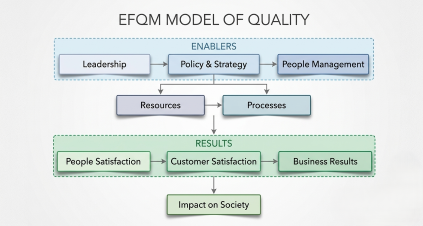
6. The EFQM Model of Quality
Evaluates how leadership drives policy/strategy, people management, resources, and processes to achieve customer satisfaction, people (employee) satisfaction, societal impact, and superior business results.
To capture workforce data comprehensively, the Council for Excellence in Management and Leadership (2002) recommends tracking metrics across five operational categories: morale (e.g., turnover, sickness), motivation (e.g., appraisal completion rates), investment (e.g., training spend per employee), long-term development (e.g., leadership skill gaps), and external perception (e.g., job offer acceptance ratios).
Human Capital Reporting
Human capital reporting communicates data regarding workforce management to both internal and external stakeholders.
External Reporting
The Accounting for People Task Force Report (2003) recommended that public companies include human capital disclosures in their Operating and Financial Review (OFR). The report specifies that external disclosures should cover workforce size and composition, retention, motivation, skills, training spend, remuneration, fair employment practices, leadership, and succession planning.
The CIPD (2003b) external reporting framework advocates reporting on:
- Workforce profile and diversity.
- Senior executive remuneration and leadership quality.
- Labor cost management and alignment of people strategy with business strategy.
- Forecasted return on human capital investments over a 3- to 5-year horizon.
Internal Reporting
Internal reporting focuses on guiding operational decisions and executive strategy. Standard Chartered Bank utilizes a “Human Capital Roadmap” supported by Gallup G12 engagement analytics to link branch employee engagement directly to financial performance. Nationwide provides area managers with visual dashboards that track pay commitment, length of service, coaching, retention, and customer service ratings, enabling immediate targeted interventions.
Conclusion
Within Michael Armstrong’s A Handbook of Human Resource Management Practice, Human Capital Management serves as a metric-driven bridge within the overarching framework of Managing People. By combining the asset-investment philosophy of HRM with statistical measurement, HCM provides the empirical evidence required to validate HR’s contribution to shareholder value and organizational effectiveness.
Sources: Armstrong, Michael. A Handbook of Human Resource Management Practice. 10th ed., Kogan Page, 2006 [1–5].